A Day in the Life at Wise Living Yoga: What to Expect During Training
September 29, 2026
By 5:30 AM, Chiang Mai is still mostly asleep — the streets quiet, the air just cool enough that you’ll reach for a light jacket. That’s exactly when a Wise Living Yoga day begins.
People ask us all the time what a typical day actually looks like during our Yoga Alliance–certified 200-Hour Yoga Teacher Training in Chiang Mai. So here it is — no polish, just what really happens from the moment the alarm goes off to the moment you fall asleep.
First, a quick note on why the course runs for 28 days instead of 21. A few schools compress the whole syllabus into three weeks. We’d rather not rush past the parts of a traditional Hatha Yoga Teacher Training that actually change how you practice and teach — anatomy, philosophy, the therapeutic side of asana. Twenty-eight days gives us room to go deep without cutting anything out. Monday through Friday is intensive, Saturday is a half day, and Sunday is yours — rest, explore, or do absolutely nothing.
The approach behind all of it is meant to be holistic and scientific, but rooted firmly in tradition. Physical health, mental health, emotional health, spiritual health, and social health aren’t treated as separate boxes to check off — they’re woven into the same days, sometimes the same hour.
Here’s how one of those weekdays unfolds.
5:30 AM — The alarm goes off
Not gently. Most students will tell you the early wake-ups are the hardest part of the whole month — especially those first few days. And then, somewhere around day four or five, something shifts. The alarm stops feeling like an ambush and starts feeling like the start of something you actually look forward to.
6:30 / 7:00 AM — Morning practice
This is Hatha yoga, the foundation of a 200-Hour Hatha Yoga curriculum — asanas, pranayama, breathing exercises, shanti mantras, and Om chanting to open the session. What we teach here is traditional yoga, not a fitness-studio adaptation of it — the sequences, the pacing, the emphasis on breath, largely unchanged from how it’s always been taught. It’s authentic yoga in that sense, practiced close to its roots rather than reshaped for a trend. A room full of voices chanting together, off-key in places, in sync in others — it’s slow and deliberate, and it sets the tone for everything that follows in a way that’s genuinely hard to explain until you’ve sat through one yourself.
8:30–10:00 AM — Breakfast and a breather
Breakfast is simple and nourishing — nuts, fresh fruit, plant-based milk. After that there’s some downtime before the next session: laundry gets done, messages home get answered, a few people quietly fall back asleep for twenty minutes.
10:00 AM — The walk to the yogashala
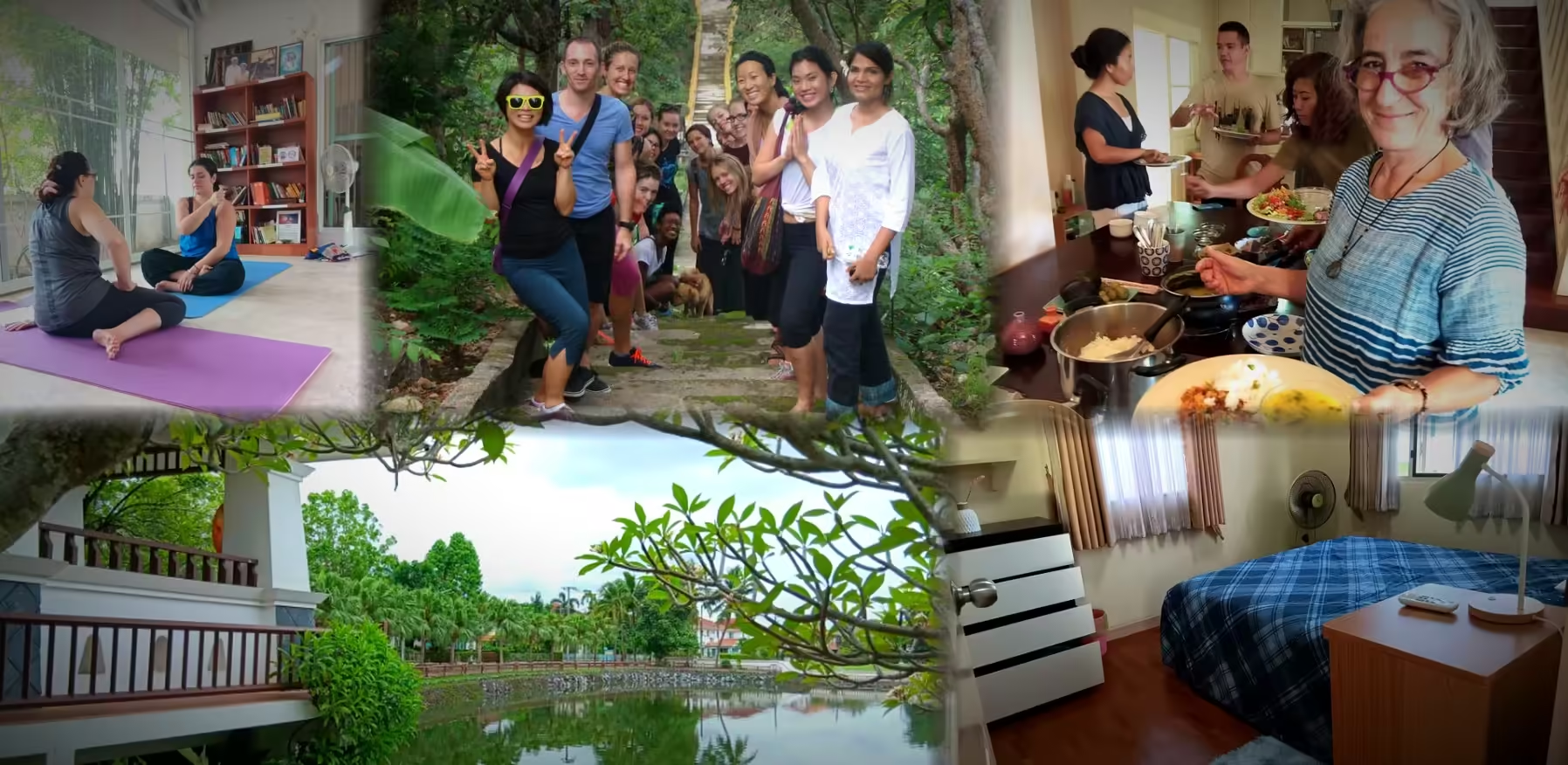
Our rooms sit about eight minutes on foot from the yogashala, and honestly, it’s one of the nicest parts of the day — past a huge lake, under the trees, birds everywhere. It doesn’t feel like a commute. It feels more like a transition, a few quiet minutes to shift gears before the next session starts.
10:15 – 11:15 AM — Philosophy session
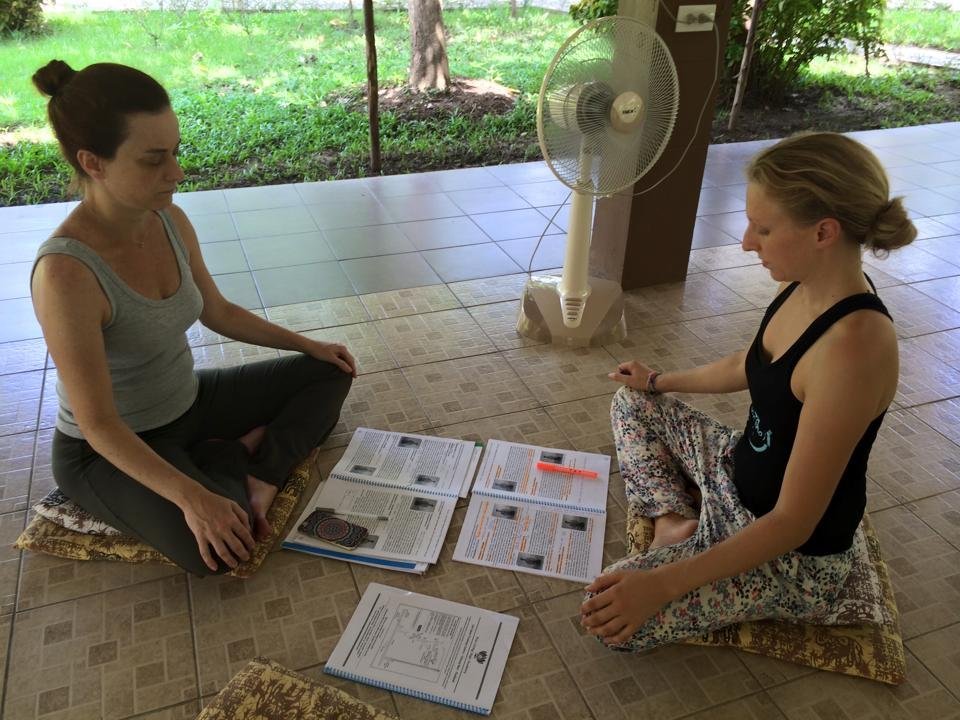
Every day there’s a new “quote of the day” written up on the board, and the first teaching session is built around it — drawing from the Bhagavad Gita, Patanjali’s Yoga Sutras, and the history of yoga. It plays out more like a conversation than a lecture, and it’s usually where the bigger questions come up — the ones people came here to ask, even if they didn’t know it when they signed up.
Sanskrit is part of the daily study too — not just chanted, but translated word by word so nothing gets lost along the way. That’s something a lot of Western-style trainings skip over, and without it, a good chunk of yoga’s actual meaning tends to go missing. This isn’t the gym-style, fitness-first approach some schools lean into — it’s traditional Indian-style yoga, taught close to the way it’s been taught for generations.
11:15 – 11:45 AM — Pranayama
Anulom-Vilom, Bhastrika, and Bhramari pranayama — each one doing something specific: respiratory health, calming the nervous system, mental clarity, proper oxygenation of the blood. It’s a short session, but it’s the part of the day a lot of students say they notice the difference from almost immediately.
12:00 – 1:00 PM — Lunch
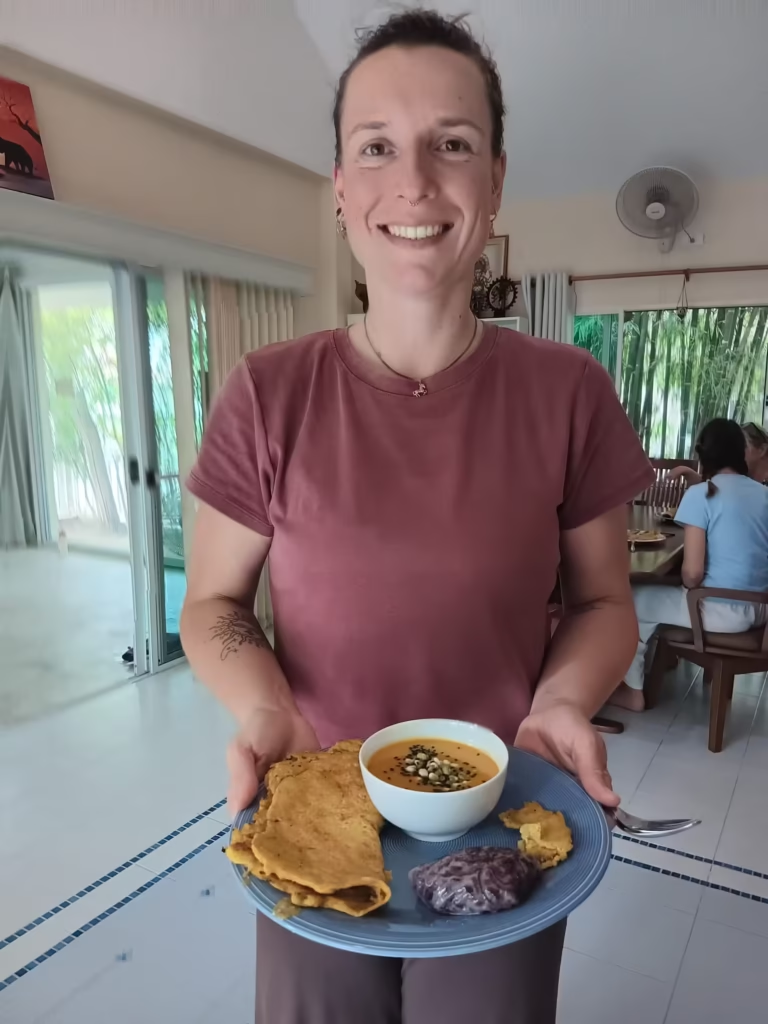
Lunch is a mix of Thai and Indian food — think khichdi, fresh salads, and vegetables cooked a few different ways with local spices, always easy on digestion. Coconut shows up a lot too, in curries and chutneys. Herbal tea and fruit are available all day whenever you need a break.
2:30 – 6:30 PM — Afternoon and evening
Afternoons shift into yoga for digestion, followed by sessions on yoga lifestyle, nutrition, anatomy, the chakras and nadis, kriyas, and the science behind clinical asanas — why certain poses actually help the body, not just how to hold them. By this point in the day, the room usually feels less like a classroom and more like a group of people figuring something out together.
8:30 PM — After dinner
Once dinner’s done, most people walk down to the lake for a quiet stretch of meditation before bed. Lights out is around 9:30 PM — earlier than most people are used to, but by the second week it starts to feel completely normal, even welcome.
Who’s teaching
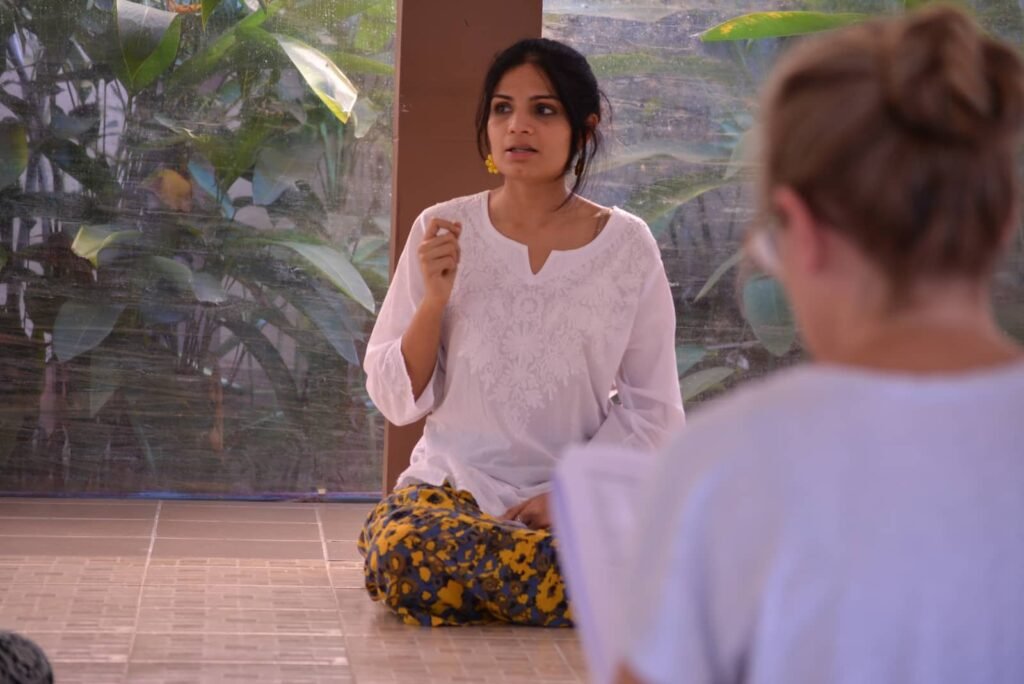
Most of the core sessions are led by Jeenal Mehta herself, and that matters more than it might sound. You’re not being handed off between rotating instructors — she’s there, day after day, for the whole month. Groups stay small on purpose, too. This isn’t a factory-style setup with a new batch cycling through every few days — it’s closer to an Indian ashram or gurukul, where the teacher actually knows where each student is struggling, and correction and feedback happen daily, not just at the end of a module.
Beyond the daily schedule
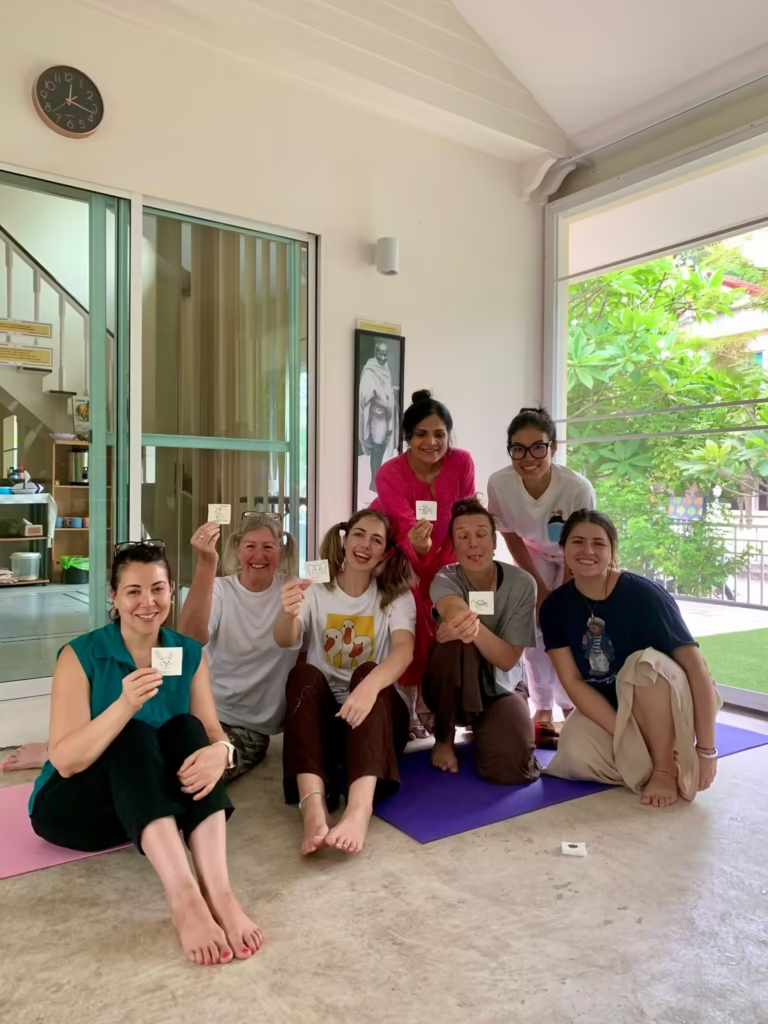
There are excursions too: trips up into the mountains to visit Thai temples, time set aside for meditation, and sessions on the life and philosophy of the Buddha. And maybe the detail that surprises people most — the training actually takes place at Jeenal’s own home. It’s not a resort or a rented facility. It’s a real, lived-in space, and that changes the whole feel of the month — closer to a family setting than a classroom. It’s homely in a way that’s hard to fake — the kind of place where, by week three, you’ve stopped feeling like a guest.
Twenty-eight days is a long time to live by someone else’s clock — up before sunrise, asleep before most of Chiang Mai has finished dinner. But somewhere in that rhythm, most people stop counting the days left and start noticing what they’ve picked up without realizing it: a chant they didn’t know by heart in week one, a friendship they didn’t expect to make, a version of themselves that shows up to a 5:30 AM alarm without complaining anymore.
That’s a day at Wise Living Yoga — early mornings, long sessions, good food, and by the end of it, a rhythm that most students say they miss the moment they leave. It’s also part of why this yoga course in Chiang Mai keeps turning into one of the best Yoga Teacher Training experiences in Thailand — because it never feels mass-produced.
Still weighing your options? We’ve also written about why Chiang Mai itself is one of the best places in Thailand to train, and a step-by-step guide to getting certified if you want the fuller picture before committing.
Curious what the full 200-Hour Yoga Teacher Training in Chiang Mai involves, start to finish? Take a look at the course details here.
Frequently Asked Questions
What time does the day start during the training?
Wake-up is at 5:30 AM, with morning practice starting around 6:30/7:00 AM. It’s an early start, but most students say it stops feeling difficult by the second week.
Is the daily schedule the same every day?
Weekdays (Monday to Friday) follow a similar intensive structure — morning practice, philosophy, pranayama, and afternoon sessions. Saturday is a half day, and Sunday is completely free.
How much free time do we get during the course?
There’s downtime after breakfast, herbal tea and fruit are available all day, and Sundays are fully yours to rest or explore Chiang Mai.
Is the food vegetarian?
Yes — meals are a mix of Thai and Indian vegetarian food, including khichdi, fresh salads, and vegetables cooked a few different ways with local spices.
Do I need to know Sanskrit or have prior yoga philosophy knowledge?
No. Sanskrit terms are translated word by word as part of the daily philosophy sessions, so no prior background is needed.
Where does the training actually take place?
At Jeenal Mehta’s own home in Chiang Mai, not a resort or rented facility — which is part of what gives the course its close-knit, family-like feel.
200-Hour Yoga Teacher Training Fees & Upcoming Dates
Ready to take the next step? Wise Living Yoga Academy offers upcoming 200-hour Yoga Teacher Training programs in Chiang Mai, Thailand, with all-inclusive options and special early-bird discounts.
Upcoming training dates include:
- October 4 – October 31, 2026
- November 22 – December 19, 2026
- January 3 – January 31, 2027
- February 7 – March 6, 2027
- June 13 – July 12, 2027
Course fees, room options, early-bird discounts, inclusions, and availability may vary by training date.
[View Fees, Dates & Course Details]
Limited spaces are available, so we recommend checking the latest course details and reserving your place early.
Author

Categories: About Us, Education, Teacher Trainings, Yoga Inspiration, Yoga Teacher Training, Yoga Therapy
